Solo product · gamescore.cards
GameScore
A production PWA for tracking board-game scores: offline-first, no account and no server, with BoardGameGeek search wired in and a paid Pro tier. Designed, built, shipped and operated solo, with Claude Code as the force multiplier.
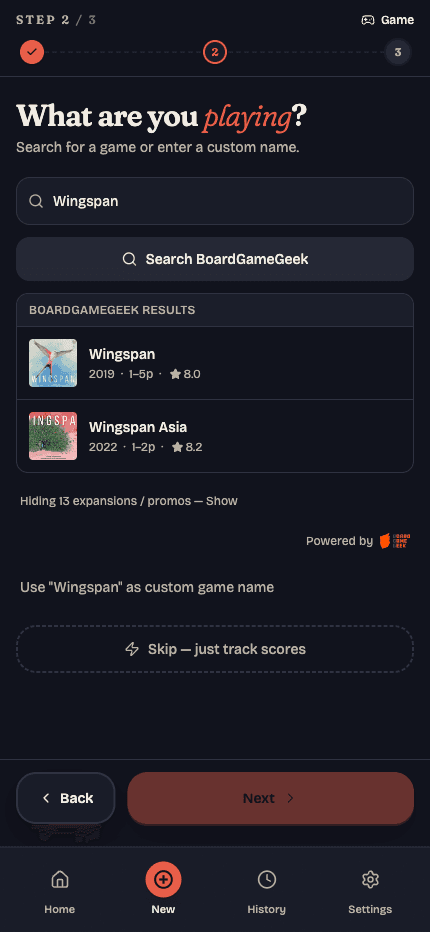
Game search - BoardGameGeek's XML API, proxied and parsed server-side.
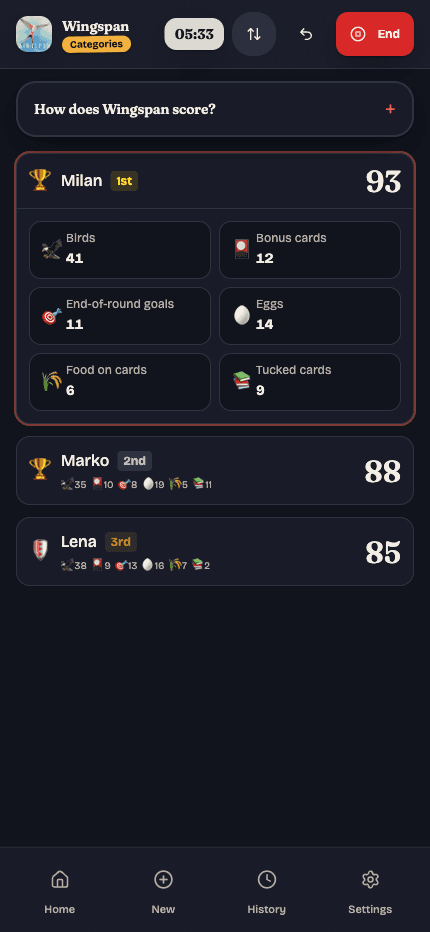
Live scoring - the Wingspan template tracks all six end-game categories per player.

The Victory Card - rendered client-side at 1080×1920, ready to share.
The problem
Board-game groups keep score on scraps of paper and half-broken apps. The good ones assume you're always online; the offline ones can't find your game. I wanted something that loads instantly at a kitchen table with no signal, knows essentially every game in print, and turns a finished match into something worth sharing.
Constraints that shaped the build
- Offline-first is non-negotiable - scoring happens where Wi-Fi isn't. All state lives on-device; there are no accounts and no cloud sync, with JSON export/import for backup.
- Adding a game pulls metadata from BoardGameGeek's API - that lookup must be fast and must never block scoring, so each game's details are snapshotted locally the moment it's added.
- It's a solo project with a real cost ceiling - the infrastructure had to be cheap to run and near-zero to operate.
- A paid Pro tier means real payments, license checks and a feature boundary that can't leak.
Key decisions
I built on Nuxt 4 for a single TypeScript codebase across rendering, routing and server endpoints, with Pinia for state. The core is local-first: Dexie over IndexedDB holds matches, players and snapshotted game data, so scoring never blocks on the network. BGG search runs through a small Nuxt server route that proxies and parses BoardGameGeek's XML API; the fields that matter are denormalized into the match, so a game's name and box art stay available offline once it's been added.
The whole thing runs on Vercel - Nuxt server routes for BGG search and license verification, with Vercel KV holding Pro license keys (there is no user database). Payments are a one-time €4.99 through Lemon Squeezy, which also handles EU VAT. Pro features sit behind a server-verified license check so the boundary holds even though the app is otherwise offline-capable. Victory Cards are rendered client-side with html-to-image into shareable 1080×1920 images people actually post.
Architecture at a glance
- Client: Nuxt 4 PWA (@vite-pwa/nuxt), installable, with a service worker caching the offline shell + assets.
- Local data: Dexie / IndexedDB as the source of truth for in-progress and historical games - no accounts, no server DB.
- Game search: BoardGameGeek XML API via a Nuxt server route (fast-xml-parser); results snapshotted locally on add.
- Backend: Vercel-hosted Nuxt server routes; Vercel KV stores Pro license keys.
- Monetization: one-time €4.99 via Lemon Squeezy; license verified server-side and fenced behind that check.
- Victory Cards: generated client-side with html-to-image (1080×1920); Sentry for monitoring, Umami for analytics.
Where the AI workflow earned its keep
GameScore is the clearest proof of the workflow I write about: a single engineer carrying design, frontend, edge backend, data modelling and ops. Claude Code, driven by the Claude Code setup I publish in claude-setup, is what made that scope tractable solo - planning loops for features, AI-assisted refactors with guardrails, and a typed memory system so the model kept the thread across long sessions.
Outcome
A live, production PWA with a paid tier, shipped and operated by one person. It answers the question every hiring manager eventually asks: can you take something from nothing to production, end to end? Here it is, and you can click it.